Hurricane season does not automatically suspend, cancel, or change a New York life insurance claim. If the insured dies during a hurricane or tropical storm, you generally follow the same basic claim process: notify the insurer, request and submit the required claim forms, provide proof of death, and respond to reasonable requests for information. Storm conditions can still cause practical delays when death certificates, medical records, mail, transportation, power, banking services, or communications are disrupted.
Trief Olk & Dror represents New York beneficiaries in delayed, disputed, and denied life insurance claims. When a death occurs during severe weather, the central coverage questions usually remain the same: Was the policy in force, who is the proper beneficiary, what does the policy require, and has the insurer identified a valid reason to delay or deny payment?
Storm delays can affect paperwork and communications. They do not automatically cancel your right to make a life insurance claim.


Does Hurricane Season Change the Rules for a New York Life Insurance Claim? 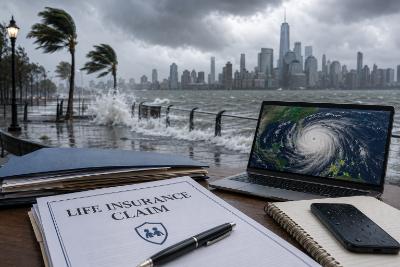
The Atlantic hurricane season runs from June 1 through November 30, with most activity occurring from mid-August through mid-October. A hurricane warning, tropical storm, flood, or major power outage does not create a separate life insurance claim system in New York.
New York regulators expect life insurers to maintain disaster planning and business continuity procedures so they can continue serving policyholders and beneficiaries when severe weather or another emergency disrupts normal operations. Those procedures address functions such as claims handling, customer communications, premium processing, staffing, technology, and alternative ways to continue essential services.
For you as a beneficiary, a hurricane may affect how quickly records can be obtained or transmitted. It does not erase the insurer’s obligation to process the claim under the policy and applicable law.
If the Insured Dies Because of a Hurricane, Will Life Insurance Pay?
In many cases, a standard life insurance policy can pay the death benefit when the insured dies during a hurricane, tropical storm, flood, or another natural disaster. The policy language controls, and specialized coverage such as accidental death and dismemberment insurance may apply separate definitions, conditions, or exclusions.
You should not assume that a storm-related death is excluded simply because a hurricane, flooding, falling debris, or another weather event contributed to the death. Trief Olk & Dror discusses this issue in more detail here:
https://lifeinsurancelawfirm.com/cause-of-death-usually-does-not-impact-life-insurance-payment/
The insurer may still review issues that are separate from the storm, including:
- Whether the policy was active on the date of death
- Whether you are the proper beneficiary
- Whether a policy exclusion applies
- Whether the policy was within a contestability period
- Whether the insurer claims that a material application misrepresentation occurred
- Whether there is a dispute between competing beneficiaries


Why Can a Hurricane Slow the Life Insurance Claim Process?
A hurricane can interfere with the documents, agencies, businesses, and communication systems that a life insurance company or beneficiary relies upon. A claim may take longer because:
- A death certificate has not yet been issued, amended, or corrected
- A medical examiner, hospital, funeral home, or government agency is operating with limited staff
- Mail service or physical office access has been disrupted
- Medical, accident, or government records are located in an area affected by flooding or power loss
- You have been displaced and cannot readily access policy or financial records
- A bank or financial institution is experiencing temporary service interruptions
- Family members are trying to coordinate records from different locations
- The insurer is waiting for records from a third party affected by the storm
A delay caused by unavailable records is not the same as a claim denial. Ask the insurer to identify in writing what it still needs, why the requested item is relevant, whether a digital copy is acceptable, and whether another document can be used while the original record is unavailable.
Keep copies of every document you submit. Record the date, method of delivery, claim number, and the name of the insurer representative who received or requested the information.
If your claim remains under investigation without a clear explanation, review:
https://lifeinsurancelawfirm.com/new-york-life-insurance-claim-lawyer/
We contacted Trief, Olk & Dror to help us with a life insurance issue and Shelly Friedland was the attorney assigned to our case. Before Shelly took our case she explained to us that the likelihood of our success without going to court was possible but not likely. Unfortunately we did not get the outcome we had hoped for but it was our decision to not move forward and have our case litigated. Shelly is very knowledgeable and was very straight-forward in her assessment of our case as we moved forward. She was very patient and thorough in answering our questions. She always responded in a timely manner and listened to our concerns. We would certainly recommend Shelly and would use her firm again in the future.” - John Ramig If there is any possibility of winning your life insurance case – this is the place to do it for you. They are efficient, honest and will achieve the best possible outcome. Shelly Friedland worked on my case where a life insurance policy had lapsed and was even a few days beyond the grace period. Farmers had rejected my claim twice and was unwilling to take a second look. Shelly was able to get them to pay the entire claim without going to court, and the full amount was deposited in my account within a couple months. Highest recommendation.” - Kathleen Brown Trief, Olk & Dror is a superior law firm. Their attorneys and other legal professionals have a brilliant understanding of the law and the litigation process. They diligently perform their work in an efficient, strategic and cost-effective manner to ensure the best possible outcomes for their clients. - Christopher Hughes
What If the Storm Disrupted a Premium Payment?
Premium issues can become central to a claim when a storm interrupts mail delivery, banking access, automatic payments, or communication with the insurer. You may later be told that the policy lapsed shortly before the insured died.
New York individual life insurance policies generally include a grace period after a premium due date. For many policies, the statutory grace period is 31 days or one month. Policies in which the amount and frequency of premiums may vary can be subject to a different statutory rule. If the insured dies during an applicable grace period, the policy can remain in force, subject to the policy terms and any permitted deduction for unpaid premium.
Review the payment history carefully. Useful records can include:
- Bank statements
- Canceled checks
- Automatic-payment records
- Credit card statements
- Insurer billing notices
- Returned-mail envelopes
- Emails or text messages concerning payment
- Records showing that a payment was attempted
- Records showing a change in the insurer’s billing or payment procedures
Trief Olk & Dror provides more information about life insurance grace periods here:
A hurricane does not automatically excuse every missed premium. Storm conditions may still matter if the insurer’s records, notices, payment systems, or communications were affected. Event-specific relief can also depend on government or regulatory action issued for a particular disaster. Do not assume that a general payment extension applies unless you can confirm it.
Settlements & Verdicts
Can the Insurer Investigate a Storm-Related Death?
Yes. A life insurance company can investigate legitimate claim questions even when the death occurred during a hurricane. The scope of the review should relate to the issue the insurer says it is investigating.
Depending on the claim, the insurer may request:
- A certified death certificate
- Medical examiner or autopsy records
- Police, fire, emergency response, or incident reports
- Medical and pharmacy records when relevant to a contestability review
- Premium payment and reinstatement records
- Beneficiary designation forms
- Employer plan documents for group life insurance coverage
A storm-related death does not give the insurer an unlimited basis to search for unrelated reasons to avoid payment. If the insurer relies on an exclusion, alleged lapse, alleged application misrepresentation, or beneficiary dispute, ask for the specific policy provision and the factual basis for its position.
For claims involving the first two policy years, contestability may become a central issue. Review:
https://lifeinsurancelawfirm.com/two-year-contestability-period/
What Should You Do During or After a Major Storm?
Focus first on personal safety and immediate family needs. When you are able to address the life insurance claim, create a written record that does not depend on one paper file or one telephone call.
Practical steps include:
- Notify the life insurer and request the current claim forms
- Ask whether electronic filing and electronic signatures are available
- Save digital copies of the policy, claim forms, death certificate, beneficiary designation, and correspondence
- Photograph or scan documents that could be damaged or lost
- Keep a timeline of calls, emails, mailings, uploads, and insurer requests
- Record claim numbers and the names of insurer representatives
- Ask for written confirmation when the insurer says that information is missing
- Track every appeal, contractual, regulatory, or lawsuit deadline that may apply
- Avoid guessing when the insurer asks for a written statement
- Tell the insurer in writing when a storm has delayed access to a requested document
Do not wait for perfect conditions when a deadline is approaching. Timing can affect your ability to appeal a denial, preserve rights, or bring a lawsuit.
Read more about life insurance claim deadlines here:
What If Important Records Were Lost in Flooding or Evacuation?
The loss of paper records does not necessarily prevent you from pursuing a life insurance claim. The insurer may already have copies of the policy, application, beneficiary forms, premium history, and prior correspondence. Employers, plan administrators, insurance brokers, banks, medical providers, government agencies, and family members may also have duplicate records.
Tell the insurer in writing if a hurricane, flood, evacuation, or related emergency destroyed or made records inaccessible. Ask which documents the insurer can reproduce from its own file and which items must be obtained from another source.
When possible, request electronic copies so you are not relying only on replacement paper mail while service remains disrupted.
If the policy came through an employer, request the plan documents, summary plan description, beneficiary records, claim procedures, and relevant employment records from the employer or plan administrator. Employer-based life insurance coverage may be governed by the federal Employee Retirement Income Security Act, commonly called ERISA. ERISA-governed claims can have administrative review requirements and deadlines that differ from individually purchased policies.
When Does a Hurricane-Season Claim Become a Legal Dispute?
Legal review may be useful when an insurer:
- Denies the claim
- Repeatedly extends an investigation without identifying the unresolved issue
- Claims that the policy lapsed before death
- Relies on an exclusion that does not appear to match the facts
- Alleges a material misrepresentation
- Refuses to recognize the beneficiary designation
- Requests records that do not appear connected to the stated issue
- Gives inconsistent explanations for the delay or denial
A life insurance lawyer can compare the insurer’s position with the policy, premium history, application, beneficiary forms, death records, claim file, and governing law. The goal is to identify the actual coverage dispute rather than treating the hurricane itself as the legal issue.
Speak With Trief Olk & Dror About a New York Life Insurance Claim
If your New York life insurance claim is delayed, investigated, disputed, or denied during hurricane season, Trief Olk & Dror can review the policy, claim correspondence, premium records, beneficiary documents, death records, and the insurer’s stated reason for its decision.
The firm handles life insurance claim disputes for New York beneficiaries and offers consultations at no charge. Call (917) 914-2005 or visit:
https://lifeinsurancelawfirm.com/contact/
A consultation can help you understand the insurer’s position, the records that may matter, and the next steps that may be available based on the policy and your circumstances.
This article is for informational purposes only and is not legal advice. Consult an attorney about your specific situation.